AI is a Lie
I'm torn between calling it Artificial Inelegance or Artificial Idiocy

When generative image tools were first introduced, I loved them. They all were extremely inefficient and they primarily generated garbage. As they've become more capable, I have lost all interest in playing with them. I loathe generated text and images, and I can almost always identify slop for what it is (though that's getting harder). Here are two pages from a book of poetry I created just two years ago.


The images were generated by using the accompanied haiQu text as prompts. I've always been interested in surrealism, and these early generated images are like beautiful surrealistic excrement. The world salad machines were also good at writing shit poetry, but that output was more cringe than surreal, so I didn't save any of them. Generated content these days, of all kinds, are basically counterfeits, and there's no fun for me in that.
I’m not “anti AI.” I love technology and software. I have used some “AI tools," and will likely use some in the future. But I am also extremely skeptical and concerned about the way these new technologies are being foisted on us with dangerous haste and almost no safeguards or oversight. The people doing this are not our friends.
 Gil Duran

Don't be too quick to dismiss the above group as a lunatic fringe. The top executives of most of the large AI companies are equally deranged.
 smccroskey

Big media companies, including NYT, aren’t in the habit of publishing smart, well-reasoned, level-headed stories about AI. Their business model is making money, and they are all struggling against extinction. This isn’t really new or news. But yesterday's murders, missing young white women, two-sides-to-everything bullshit are making way for all manner of “AI is going to kill us all,” or “AI is God” fabulations [sic].
Not coincidently, the tech bro goons of Silicon Valley know how take advantage of this to feed fantastic, sensational, and even infantile blather to them, knowing it’ll help their pyramid scheme IPOs.
So it’s a nice surprise to see NYT publish an editorial by Jaron Lanier about AI.
There is an explanation for why some tech leaders, so seemingly worried about an extinction-level event, are plunging ahead with A.I. development: Mankind’s survival, while important to many of them, is less critical than building something they believe to be not only conscious but godlike. A substantial portion of the A.I. community, in celebrating this belief, is quick to support any action or statement that reinforces the idea that the technology is like a deity. They might call for regulation, but only in specific ways — perhaps by deploying more A.I. to control A.I. — that adore the technology’s powers. It is that adoration that is nonnegotiable.
There is nothing wrong with a new religion, but there is everything wrong with an imposed new religion. That is our problem. It is not the technology itself.
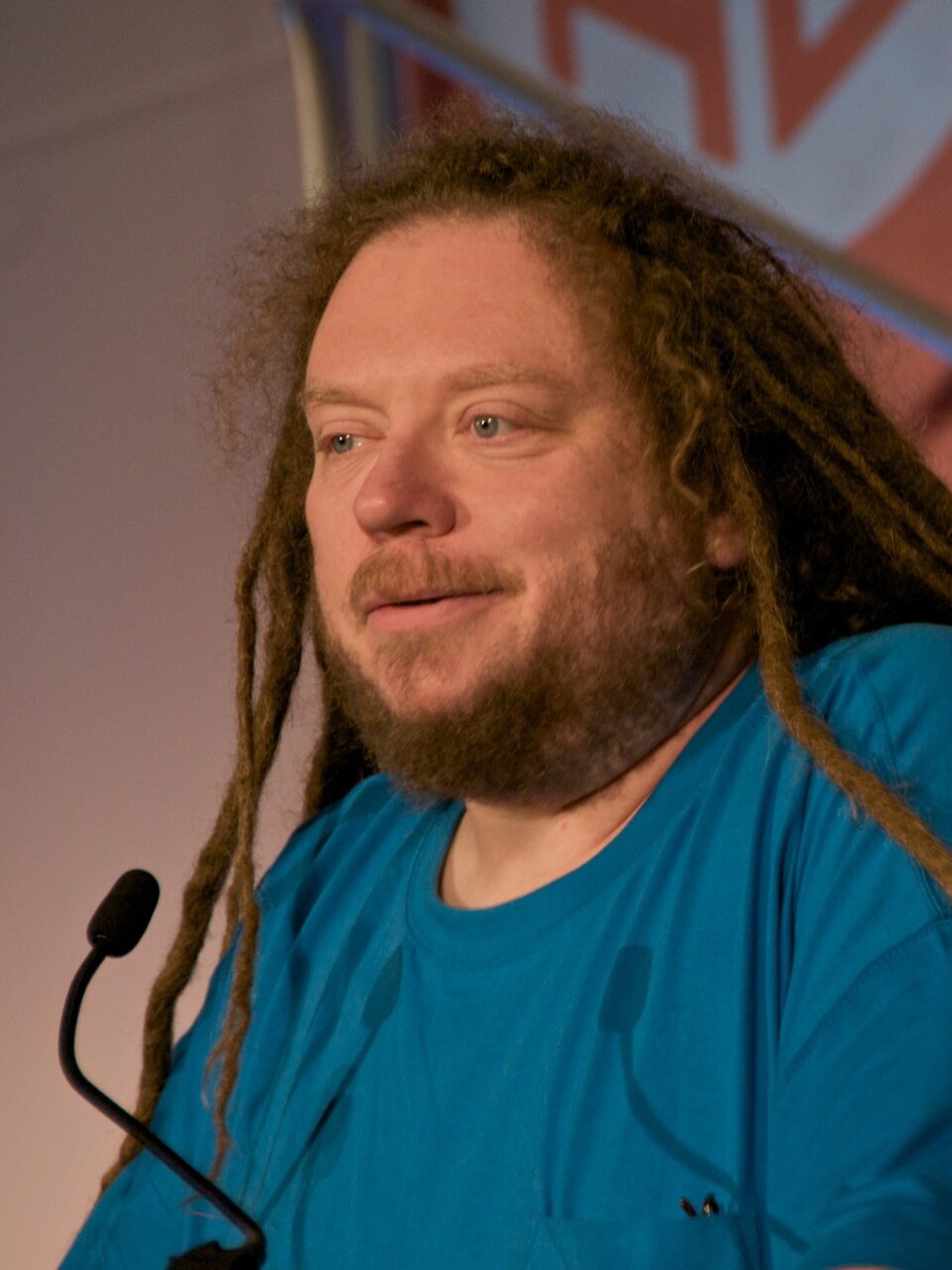
If you haven’t heard of Jaron Lanier, he’s a computer scientist, writer, artist, musician, and probably genius, a word I don’t often use. He’s also the guy who coined the term, “virtual reality.”
 Contributors to Wikimedia projects
What the fuck is AI, anyway?
Before reading further, I encourage you to review what you think you might know about it. When you use ChatGPT or its equivalent, do you believe you are having a conversation? If so, with whom do you think you are interacting? If not a human, then what? A computer? “Agent” is commonly used to anthropomorphize a kind of software application that is doing little more than following coded instructions.
Engaging in a conversation with a software program is a parlor trick.
 Joy Pope
A bit of a segue here, but here's a glimpse at some of the "many new jobs" this industry is claiming to create.
 Marché Arends and Kathryn Cleary

I get that it’s immensely helpful to use language shortcuts when talking about complex things. But “AI” is doing miraculous work—referring to some of the most massively complex software systems and networks ever created—it enables a lot of people to use it as a kind of mythical, or even mystical, phenomenon. Put more simply, the people pushing AI are intentionally using the complexity of it, to manipulate the media—and you—into allowing them to influence and infiltrate our government and military. The military industrial complex, along with the US government, has been infiltrated by Big Data corporations in creating what can only be called The Panopticon.
 Andrea Coveri

 XXXXXXX.XXXXXXX
So, back to: what is AI?
I found the following article to be extremely helpful in understand what we’re really talking about.
Esther Weidauer describes himself thusly:
I have professionally worked in software development for about 15 years, and got about 25 years of programming experience across several languages in total. I have worked a lot on search engines and have implemented my own neural networks occasionally.
Weidhauer takes a clear anti-AI stance in the title of his essay, “Why I Resist Generative “AI,”” but in laying out his opposition, he offers some very smart and succinct descriptions of its many components.
If you’re not interested, or if you don’t have the time, to click on all the links I’m sharing, this is the one I most hope you’ll read. The most salient sections of this essay are Claims, Harms, and especially the final one, which should alarm you, The Weird.
 Esther Weidauer
Jaron Lanier isn't only one who sees promise in these new technologies, so I'll end on a less alarmist take on it. Here's Payal Arora, professor and chair in Inclusive AI Cultures at Utrecht University and founder of the Inclusive AI Lab.
While the U.S. is building and deploying AI at a scale no other country matches, Americans are deeply anxious about where it is heading. Only 17% of U.S. adults think AI will have a positive impact on the country over the next 20 years, according to a 2025 Pew Research Center survey.
In much of the Global South, the mood is markedly different. Stanford’s 2025 AI Index found that 83% of respondents in China, 80% in Indonesia, and 77% in Thailand said AI-powered products offer more benefits than drawbacks, compared with 39% in the U.S. and 36% in the Netherlands.
So why the divide?
 Rina Chandran
The harms of this technology is to broad and too extreme for now that I'm not willing to support the industry by using their tools. And for now, don't waste your time looking for 'ethical' or 'sustainable' AI tools. I've gone down that rabbit hole and have only found more shysters and cons.
Stay safe out there.